ShoppingHub
Democratizing enterprise procurement
Background
Sourcing is something we all do online now. When we have a desk job we often fumble through cabinets and ask the IT team for cables. Unfortunately employees find this to be more than an unpredictable experience for procuring products and services. Some employees make purchases regularly and the teams that support them need a seamless way to interface with them.
Our challenge?
Create a shopping experience that works for the enterprise but matches employees expectations.
Meeting employers (and the teams that support them) where they are.
Sourcing is confusing to employers and the tools to support them are disparate and are often lacking. How can we rethink them?
-
As an employee I have a need for a product or service that our company doesn’t have on hand. How am I to get what I need through our company without jumping on the phone with procurement?
-
If users can satisfy their regular needs for goods and services without the need to engage directly with procurement teams, they will be pleased and able to focus on their jobs.
-
Provide a consumer grade shopping experience in the enterprise that matches their expectations and frees up employees and the teams that support them to focus on their jobs.
-
Product Design lead ( with 1 other designer)
Research (support)
Visual design
Product strategy
Click image to enlarge
Early considerations:
Without customers we will depend on primary and secondary research efforts
Without a consumer-grade design system we’ll have to design and build some custom componentry
For reasons of scope the primary focus will be on the shopper vs. the fulfiller
The Process (EDM)
Understand
The learning plan
Understand the nuance of shopping in the enterprise
Research methods
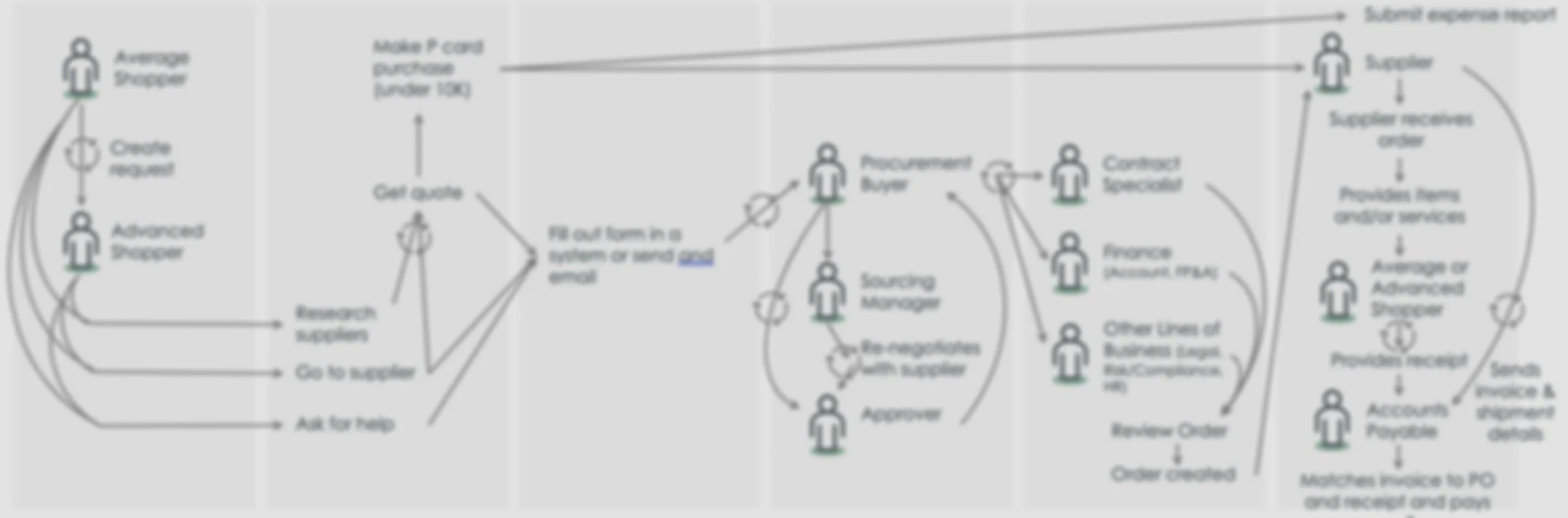
User journey map:
Track activities and the people behind them
Understand their thought process
Feel their pain
Competitive analysis:
Internal review of Gartner “visionaries” report
13 organizations reviewed
Key learnings as input to strategy and design direction
Click image to enlarge
In-depth Interviews
Remote or in-person discussions to understand their current processes
16 General Population (US, UK, Australia)
19 ServiceNow
14 KeyBank
4 Pure Storage
Our key questions:
Who are the different types of shoppers and what are the challenges they have?
What is the enterprise shopping process today?
What are shopping behaviors and do they change based on requesting a good or service?
What is important to shoppers in a various contexts (i.e. mobile)?
What is it important for shoppers to do? (jobs to be done)
Click image to enlarge
What are the key user flows? (E2E use cases)
Click image to enlarge
What do enterprise shoppers need access to? (functionality & content)
Click image to enlarge
Learnings:
There are a spectrum of shoppers (Average through advanced) with quite different needs
The various shopper types range from very little to extensive knowledge and experience of the procurement process
Purchasing for work is a highly transactional experience. Shoppers want in and out
Surprisingly, there is a lesser desire for the ability to shop on mobile; more-so a desire to track status there
Detailed findings:
Purchase processes and tools are complex and illogical
Shoppers don’t have any visibility into the purchasing process once they submit a request
Shoppers spend time clarifying their intent for a purchase
Shoppers only know of issues when things don’t go as expected
Click image to enlarge
Opportunity assessment
How might we define a better experience for our personas?
Click image to enlarge
Ideate
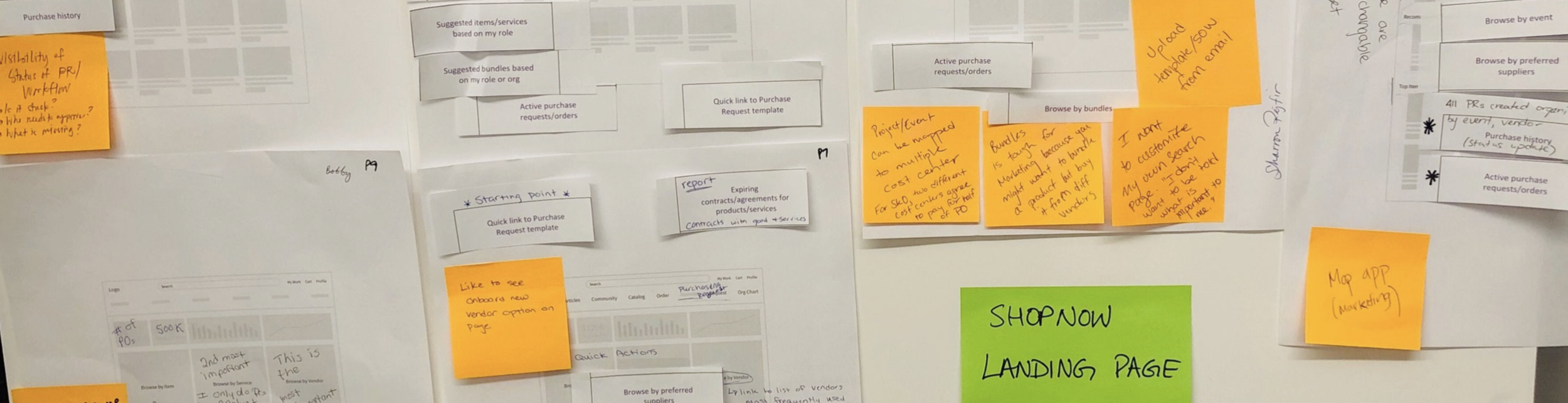
Exploring our users, their needs and expectations
Let’s get inputs to our initial concepts…
Personas
Average shopper (primary) : Anyone in the company who orders goods or services occasionally
Advanced shopper (primary) : Shoppers who place requests on behalf of Average Shoppers as part of their job
Approver / Fulfiller (secondary) : Those who approve purchases and/or facilitate communications with the business and suppliers
Needs assessment
We looked at what features were important to customers across previously identified key needs and workflows
Click image to enlarge
Click image to enlarge
Market Scan - Consumer Shopping
We looked for external inspiration and to benchmark the landscape
Click image to enlarge
Design principles
We defined design principals to support team alignment and aid in decision making
Use plain english and friendly language
Blur the lines between personal & professional
Have meaningful transactions - Persona-based efficiency
Provide a concise, clear, simple contextual experience
Early concepts
Divergent thinking that took into account a variety of mental models
Click image to enlarge
“Provo”typing / Usability testing
Deliver prototypes to help narrow in on a solution
Prototype Evaluation
Assess value we provide compared to their current experiences
Determine if the prototypes are intuitive
Participants:
9 K19 attendees
16 general population
1 design partner
Scenario 1 / Desktop flow
Marketing professional (Average Shopper): Pretend you are a marketing events coordinator named Joe who has been tasked to work on a PowerPoint presentation for an upcoming event. You need help to create a polished presentation, so you decide to start by going to your company's employee portal.
Scenario 2 / Mobile flow (Advanced Shopper)
Pretend you are an IT inventory manager and receive a notification on your phone that lets you know the inventory in the Santa Clara stockroom is running low. An Auto Order has been created for you. You need to decide how you'd like to proceed with the order.
Scenario 3 / Mobile flow (Average Shopper)
Pretend you are a Field Service Agent who works for ACME Corp and you are at a customer's office, Cloud Vortex, to look into an issue they reported. You see that Cloud Vortex has a few different routers, and, due to a fan overheating, the routers need to be replaced with new fan kits. To respond to Cloud Vortex's case promptly, you decide to use your mobile phone to scan the barcode of the router so you can get a replacement kit for them. Go ahead and complete the order.
Summary of results
It is a huge improvement over what they currently use for several reasons:
Transparency in the purchasing process, with recent order updates, clear timelines of what to expect and when, who to follow up with if necessary. This avoids the hassle of filtering through numerous emails which is what most currently do
Easier to find multiple suppliers for a good/service because all the information is consolidated in one place
Ability to quickly order previously purchased items/services, either through ‘Buy it Again’, ‘Saved’ or ‘Auto-order’. Many shoppers purchase the same items/services repeatedly and regularly, but have to recreate the orders every time with their current systems
Ability to see their remaining budget. This helps them know how much they can afford to spend without hav ing to pull up reports, or track down someone who has the ability to pull that information
Visually more appealing, and intuitive, because it feels like a consumer shopping experience and matches my expectations
Define
Changes during the design lifecycle need to be addressed
Our VX guidelines had changed and needed to be incorporated
We had to pivot from Employee Portal integration to launching as a standalone
Final designs
Click image to enlarge
Click image to enlarge
Implement
Development hand-off
All designs delivered as Figma-based files
Dev kick-off and follow-ups to ensure design consistency
Click image to enlarge
Challenges with hand-off
Development team was in India making timezones a challenge
Scheduled early meetings
Made screen recordings that could be viewed “offline”
Development team was working with designers in some cases for the first time
Educated dev team on our function and processes
Solicited input on “best-path” to effective collaboration
Cut short a physical visit due to Covid. : (
Go live / 1st year customer base
Have 5 live customers and ~45 in pipeline (includes GE Healthcare, Nascar)
~500K to 750K with ~12M-20M in pipeline
4 design partners
1 reference customer
Next steps / 3-year vision
Implement and review metrics (unavailable before customers)
Revisit mobile use cases
Integrate fully within the Employee Portal product
Build out a more robust fulfiller experience
Better support shopper and fulfiller ESG (environmental, social and governance) needs
Partner with Supplier Lifecycle Management and Accounts Payable and Legal team to support more broad workflows
Update design principles to account for recent 3-year vision